Merkaba Meaning: The Star Tetrahedron & Light Body

Founder & Editor • Published
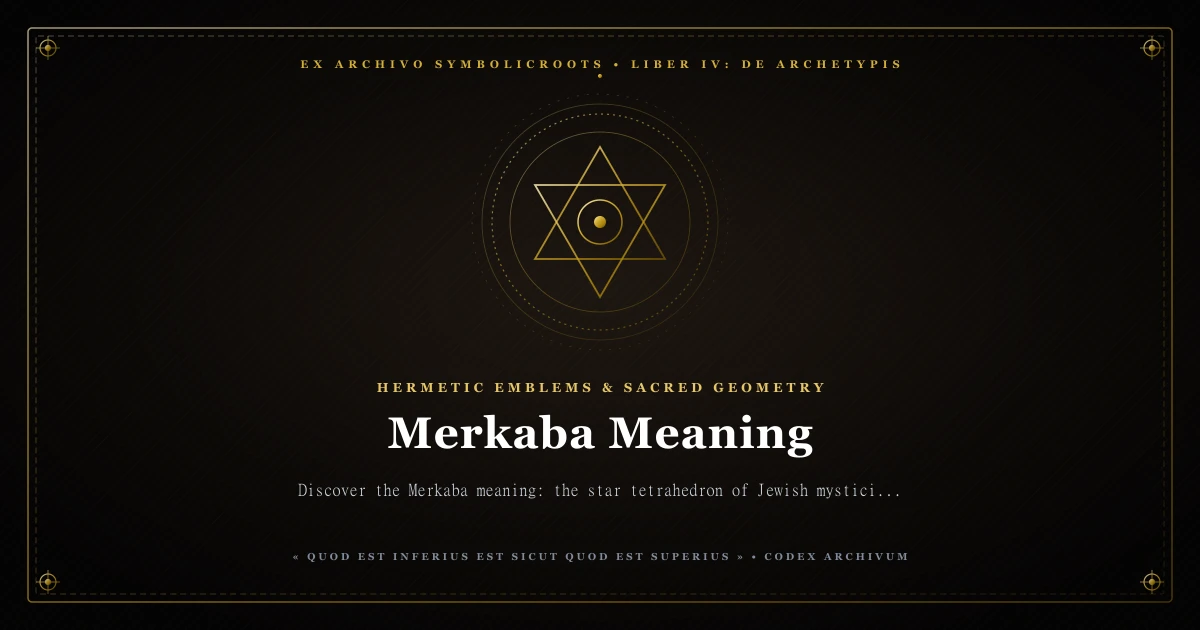
"The Merkaba is a star tetrahedron — two interlocked triangular pyramids spinning in opposite directions — read in Jewish mysticism as the divine chariot and in modern sacred geometry as the vehicle of the light body. It symbolizes the synthesis of opposites into an engine of ascension."
Tune your mind while reading with pure acoustic frequencies (Web Audio).
Index of Sections (9)Tap to expand ↓
The first time most people meet the Merkaba, they are holding it: a small object of polished crystal or cast metal, shaped like a three-dimensional star — two triangular pyramids, one pointing up, one down, fused at their centers into a single body. You will find it in crystal shops and meditation halls, spinning in videos under the label light body. You will also find its ancestor, drawn and glossed in careful Hebrew, in 13th-century Kabbalistic manuscripts.
That range is the puzzle. What connects Ezekiel’s vision of the divine chariot to a modern meditator visualizing counter-rotating fields of light? The answer runs through one of the world’s oldest documented mystical traditions and through the symmetrical language of sacred geometry — two stories that matter, and are not the same story.
Every symbol in this archive is traced through its cultural lineage and its psychological mechanism, with sources listed at the end.
1. The Word and the Wheel: Merkaba Defined
Start with the word. Merkaba — more precisely merkavah (מֶרְכָּבָה) — is simply the Hebrew word for chariot, built on the root r-k-v, “to ride.” In scripture it names the throne-chariot of God: the radiant vehicle of creatures and wheels that the prophet Ezekiel saw by the river Chebar. In its original setting the word is concrete and royal.
Modern sacred-geometry circles, however, love to split the word into three syllables and assign each a meaning: mer as light, ka as spirit, ba as body — a reading loosely borrowed from ancient Egyptian word-elements and popularized in late-20th-century metaphysical teaching. Scholarship is blunt: the triple breakdown is a modern gloss, not the historical meaning of the Hebrew term. Older sources, from the Talmud onward, consistently emphasize the primary sense — chariot. Yet the modern reading survives because it is apt: light, spirit, and body are the very layers the symbol asks you to hold together.
Then there is the shape. The star tetrahedron is the six-pointed star given depth: interlock two identical tetrahedrons — four-faced triangular pyramids — one pointing up, one down, and you get the compound geometers call the stella octangula, first described by Johannes Kepler. The pairing is deliberate. One tetrahedron ascends, the other descends; one is read as masculine, the other as feminine; one as spirit, the other as matter brought alive from within. When the two spin in opposite directions, their union becomes not a statue but an engine.
2. Merkabah Mysticism: The Chariot of Ezekiel
The historical root of the symbol is Jewish, ancient, and specific. In Ezekiel chapter 1, written in the sixth century BCE, the prophet describes a storm-wind from the north: four living creatures (chayot), four gleaming wheels (ofanim) that move without turning, and above it all “the likeness of a throne, in appearance like sapphire” — the chariot bearing the divine Glory. It is one of scripture’s most intense visions, and it founded a mystical school.
By the Talmudic period, speculation on the chariot — Ma’aseh Merkavah, “the Work of the Chariot” — was already treated as advanced and dangerous, taught only to students of proven discretion. The Merkabah mystics proper, active roughly between 100 and 700 CE, left the Hekhalot (“palace”) texts, which map the visionary ascent through seven heavenly palaces, each guarded by fearsome gatekeepers, toward the throne itself. The practitioners — yordei merkavah, “those who descend to the chariot” — prepared through fasting, purity, and the recitation of hymns and divine names, seeking to witness the throne and stand safely in its presence.
Two points of honesty matter. First, Merkabah mysticism is a genuine historical Jewish practice with its own texts, techniques, and discipline — not a vague “energy” tradition — and deserves description on its own terms. Second, the geometric Merkaba of the crystal shop is a later development. Aryeh Kaplan, the 20th-century scholar whose translations opened Kabbalistic sources to modern readers — including the foundational Sefer Yetzirah: The Book of Creation (Kaplan, trans., 1990, Weiser Books) — traced the framework by which chariot traditions flowed into classical Kabbalah, where the chariot maps how infinite light enters structured creation. The star tetrahedron as a meditation object comes much later — but it inherits the core idea: a vehicle for traversing between realms.
3. The Geometry: Star Tetrahedron Inside the Sphere
Seen purely as geometry, the figure is where the modern tradition builds its case. The star tetrahedron belongs to the same family of diagrams as the Flower of Life Meaning, the overlapping-circles motif carved on temples across several continents. Within that family sits a hidden core called the Fruit of Life — thirteen detached circles — and from it, by connecting centers, one derives Metatron’s Cube Meaning, the figure said to contain all five Platonic solids.
The star tetrahedron is the simplest three-dimensional member of that lineage. A single tetrahedron is the first of the five Platonic solids — four equilateral triangles, the classical element of fire and the minimum shape that can enclose space. Compound two in mirrored orientation and you have a complete polarity diagram in three dimensions. Where Metatron’s Cube maps the whole architecture of matter, the Merkaba isolates a single engine within it.
One element completes the modern figure: a sphere surrounding the star, just touching its outer points. The sphere is read as the boundary of the personal energy field — the aura — with the tetrahedrons suspended at its center like a seed within a fruit. The same logic makes the Sri Yantra Meaning powerful: a bounded field of interlocking dualities, contemplated from a still center.
4. Reading the Symbol: Element by Element
Every component of the Merkaba carries a traditional interpretation, and the meanings only work as a set.
| Element | Reading |
|---|---|
| Upward tetrahedron | Masculine polarity: sky, spirit, the impulse of ascent toward source |
| Downward tetrahedron | Feminine polarity: earth, matter, the grace of descent into embodiment |
| Counter-rotation | Synthesis: opposing fields turning against each other like a dynamo, generating energy between them |
| Enclosing sphere | The aura: protection, containment, the boundary of the personal field |
| The still center | The witness: the unchanging point of awareness both fields revolve around |
Neither tetrahedron is “better” — the figure is incomplete without both, and the motion exists only because the two directions oppose each other. That is the symbol’s deepest teaching: polarity is not a problem to be solved but a fuel to be harnessed, and the self that watches the spin is not caught in it.
5. Merkaba vs Metatron’s Cube vs Star of David
These symbols share six-pointed symmetry and are constantly confused, yet they belong to different traditions and do different work.
| Symbol | Tradition | Core Difference |
|---|---|---|
| Star of David (Magen David) | Judaism | The flat, two-dimensional six-pointed star; an emblem of Jewish identity and, in Kabbalistic reading, the union of heaven and earth |
| Merkaba | Jewish mysticism; modern sacred geometry | The same star extruded into 3D — two interlocked tetrahedrons read as the divine chariot, or as the vehicle of the light body |
| Metatron’s Cube Meaning | Kabbalah-derived sacred geometry | A flat matrix of 13 circles and 78 lines mapping all five Platonic solids — a blueprint of creation, not a single solid |
| Flower of Life Meaning | Ancient motif; modern sacred geometry | Overlapping circles forming a generative lattice — the parent diagram from which the others are extracted |
The cleanest distinction is dimensional: the Star of David is a 2D mark; the Merkaba is that mark rotated into space, given volume and implied motion. Metatron’s Cube and the Flower of Life are not solids at all but maps. Think of it this way: the Flower of Life is the alphabet, Metatron’s Cube is the full sentence, and the Merkaba is one word spoken aloud.
6. Merkaba Meditation: The Modern Practice
Now to the practice you will meet in a studio or online. The popular Merkaba meditation, systematized in the 1990s and taught widely since, asks the meditator to visualize two tetrahedral fields of light surrounding the body — one apex up, one down — and set them rotating in opposite directions, the motion coordinated with counted breath cycles until the field feels stabilized, bright, and enclosing.
Said plainly: this practice is a modern synthesis, assembled in the late 20th century from Hebrew chariot imagery, Egyptian word-play, Pythagorean and Platonic geometry, and chakra-era energy anatomy. It is not a reconstruction of what the yordei merkavah did in late antiquity; their discipline was liturgical and visionary, aimed at the throne, not at spinning a geometric shield. The framing matters: the modern practice can be valued for what it genuinely does — train concentration, breath control, and body-field visualization — without borrowing unearned authority from the tradition it draws on.
Practitioners report effects familiar from other deep visualization disciplines: heightened focus, a felt expansion of personal space, and sometimes the energetic surges described in Kundalini Awakening Signs — warmth along the spine, spontaneous stillness, vivid inner light. These are real experiences of trained attention, whatever metaphysical frame you prefer for them.
7. Somatic Practice: The Two-Field Breath
To feel the symbol rather than read about it, run this three-minute protocol. Sit upright, spine tall, eyes closed or softly lowered.
- Minute one — establish the vertical. Inhale slowly (about five seconds) and imagine an upward-pointing triangle of light growing from the crown of your head toward the sky. Exhale and imagine a downward-pointing triangle growing from the base of your spine toward the earth. The triangles need not be perfect; the directions matter — one stream rising, one descending.
- Minute two — add the rotation. On each inhale, imagine the upper field gently turning to the left; on each exhale, the lower field turning to the right. Keep the breath continuous and unforced. The motions should feel like interlocked gears — opposing, generating something in the space between them.
- Minute three — rest at the center. Let the rotation fade and attend only to the still point behind the sternum or between the eyebrows — the witness both fields were spinning around. Breathe naturally. Before opening your eyes, imagine the whole figure enclosed in a smooth sphere of light, then release it entirely.
Done this way, the practice is honest to its imagery: polarity above and below, motion between them, awareness at the center. It is a concentration exercise wearing sacred geometry, standing on its own without any claim about what the field “actually” is.
8. Actionable Steps & Companion Symbols
To carry the symbol from page to practice:
- Learn the two stories separately. Read Ezekiel chapter 1 once as literature, once as the mystics read it — then notice how differently the geometric Merkaba sits in your mind.
- Practice the two-field breath daily for two weeks. Three minutes, same time each day; journal afterward — the Printable Dream Journal format works well for inner imagery.
- Draw the figure by hand. Sketch the two interlocked triangles, then the enclosing sphere; hand-drawing embeds the geometry far better than scrolling past it.
- Map its companions. Study Metatron’s Cube Meaning for the full blueprint and Flower of Life Meaning for the parent lattice — each isolates a different face of the same underlying order.
For wider comparison, browse the Cultural Archetypes & Symbols archive: the Merkaba sits beside sacred-number traditions — What Are Angel Numbers?, 777 Angel Number Meaning — and diagrams like the Sri Yantra. The Merkaba’s final lesson is shared by all of them: opposites, held in precise relationship, do not cancel. They rotate. And something that moves can, at last, be called a vehicle.
Where did you encounter Merkaba Meaning today?
Personal Integration Prompts
Carl Jung taught that archetypes remain powerless until integrated into waking conscious awareness. Sit with these questions before moving on:
- What recurring situation or emotional friction in your life mirrors this symbol's primary message right now?
- If this sign were a messenger from your subconscious, what uncomfortable truth is it asking you to stop ignoring?
- What is one concrete, grounded boundary or action you can execute in the next 24 hours to honor this insight?
"Merkaba Meaning: The Star Tetrahedron & Light Body"
"The Merkaba is a star tetrahedron — two interlocked triangular pyramids spinning in opposite directions — read in Jewish mysticism as the divine chariot and in modern sacred geometry as the vehicle of the light body. It symbolizes the synthesis of opposites into an engine of ascension."
Frequently Addressed Inquiries
What does the word Merkaba mean?
What is the Merkaba's shape and why two tetrahedrons?
What is Merkabah mysticism in Judaism?
How is the Merkaba used in meditation?
Sources, Literature & Academic Citations
Unlike generic folklore websites, every interpretation in the SymbolicRoots archive is grounded in published depth psychology, cognitive neuroscience, and foundational anthropological texts:
- [1]Kaplan, Aryeh (trans.) (1990). "Sefer Yetzirah: The Book of Creation." Weiser Books.
Alex Brovarsky
Founder & Editor
Founder and editor of SymbolicRoots. Reads dreams, signs and symbols through depth psychology and cultural tradition, listing sources for every article.