Triskelion Celtic Symbol Meaning: Triple Spiral

Founder & Editor • Published
"The Celtic Triskelion represents the eternal rhythm of life, death, and rebirth through its perpetual rotational motion. Psychologically, it mirrors the psyche's continuous individuation process, balancing conscious awareness, the unconscious, and transcendent integration."
Tune your mind while reading with pure acoustic frequencies (Web Audio).
Index of Sections (7)Tap to expand ↓
Few ancient emblems arrest human consciousness quite like the Triskelion (also known as the Triskele or Triple Spiral). Whether chiseled into the colossal megalithic kerbstones of prehistoric Ireland, embossed onto the burnished bronze shields of Iron Age Celtic warriors, or encountered unexpectedly in personal synchronicity, this sacred glyph exerts an unmistakable optical pull.
Gaze upon its curving arms for more than a few seconds, and the emblem refuses to remain static. The three interlocking spirals appear to turn, churning like an ancient cosmic engine. It evokes the rush of ocean waves, the spiral arms of distant spiral galaxies, and the unfurling fronds of forest ferns.
Unlike static talismans that project immobility, the Triskelion is pure kinetic momentum. In depth psychology and comparative mythology, encountering this symbol repeatedly is rarely accidental. It often functions as a potent synchronicity—an unconscious somatic indicator that a static, stagnant chapter of your personal journey has closed, and a dynamic triadic cycle of growth, dissolution, and renewal has begun.
1. Sacred Architecture: Anatomy of the Triple Spiral
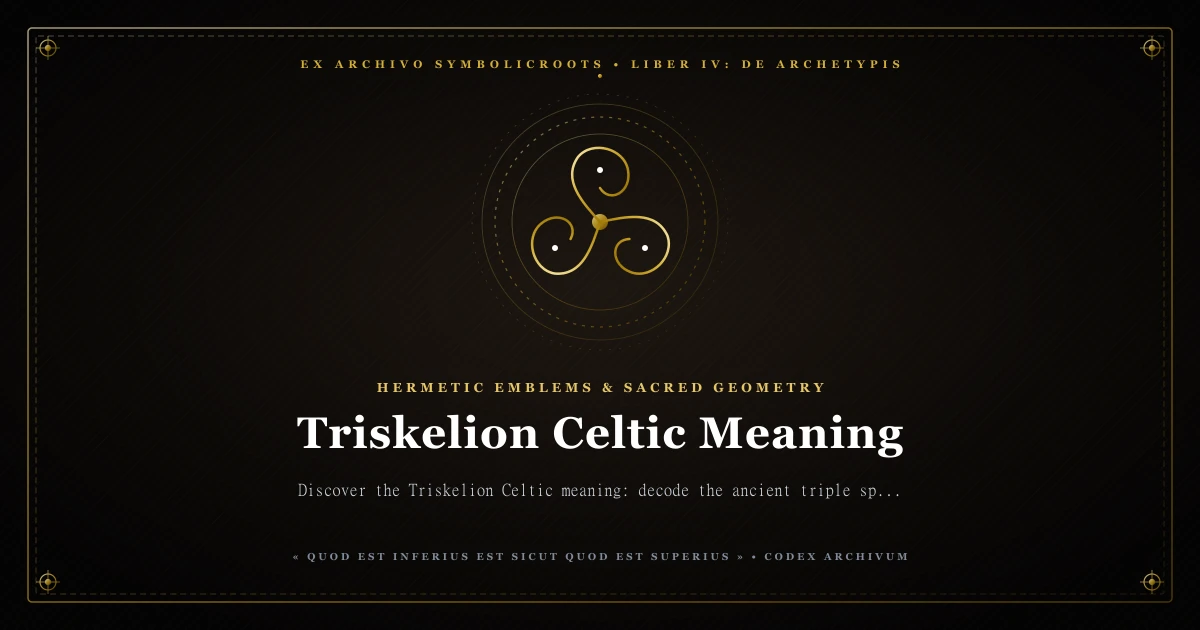
To understand the energetic frequency of the Triskelion, one must first deconstruct its geometric architecture. Rooted in the Greek word triskeles (meaning “three-legged”), the emblem consists of three congruent logarithmic spirals originating from a common, unmoving hub.
At its heart sits the Still Bindu — the timeless center — from which three arms radiate: Spirit / The Sky (inspiration and vision), Body / The Land (somatic roots and form), and Soul / The Sea (emotional depths). Around this motionless hub, the geometry turns in perpetual clockwise rotation — unbroken rebirth.
The Threefold Components
- The Still Center (The Bindu): The exact origin point where all three arms meet remains entirely motionless. In esoteric geometry, this represents the primordial Void, the transcendent Godhead, or what Carl Jung identified as the unified Self—the stillness from which all temporal manifestation flows.
- The Expanding Convolutions: Each arm curls outward in a logarithmic progression identical to the Golden Spiral ($\Phi$). It mirrors the organic expansion of natural growth: the shell of the nautilus, the unfolding embryo, and atmospheric weather vortexes.
- Rotational Directionality: Traditional Celtic triskeles typically coil inward in a clockwise orientation, symbolizing solar energy, active manifestation, creative acceleration, and conscious evolution. When drawn counter-clockwise, the emblem governs introspection, ancestral remembrance, and dissolving obsolete karma.
2. Megalithic Roots & Celtic Cosmology: From Newgrange to La Tène
While popular modern folklore associates the Triskelion almost exclusively with the historic Druids, archaeological excavations reveal that the symbol belongs to humanity’s deepest prehistoric stratum.
- Neolithic Ireland (c. 3200 BCE) — the Newgrange tomb: astronomical solstice alignment and solar birth
- Mycenaean & Minoan Aegean (c. 1600–1200 BCE) — golden funerary ornaments and marine pottery motifs
- Celtic La Tène culture (c. 500 BCE – 100 CE) — curvilinear bronze masterworks, scabbards and torcs
- Insular Christian manuscripts (600–900 CE) — the Book of Kells and Book of Durrow: Celtic Trinity illuminations
The Sunlight of Newgrange (3200 BCE)
More than five thousand years ago—long before the construction of Stonehenge or the Great Pyramids of Giza—Neolithic astronomers carved an intricate triple spiral onto Kerbstone 52 and the massive Entrance Stone of the passage tomb at Newgrange in Ireland’s Boyne Valley (Brú na Bóinne).
Every year during the Winter Solstice, a single beam of dawn sunlight penetrates a narrow roof-box above the entrance, traveling sixty feet down an underground stone corridor to illuminate the inner burial chamber. The tri-spiral glyph was carved precisely into this threshold of darkness and light. To the Neolithic builders, the three spirals tracked the triadic dance of celestial cycles: the waning, dark, and waxing moon, or the three nine-year cycles of lunar precession. It stood as a permanent architectural promise that death in the tomb is merely an incubation chamber before cosmic rebirth.
The Iron Age Celtic Synthesis
When Celtic-speaking tribes spread across Central and Western Europe during the Hallstatt and La Tène periods (c. 500 BCE onward), their metalworkers and shamans adopted the triple spiral as their supreme artistic and sacred emblem.
For the Celts, the number Three was the holy axis upon which the entire cosmos spun. Unlike Mediterranean worldviews that organized reality into rigid binary dualities (good versus evil, light versus dark, mind versus matter), Celtic metaphysics perceived the universe as inherently tripartite:
- The Three Realms of Existence: Talamh (Land / Physical Reality), Muir (Sea / Emotion and the Underworld), and Nem (Sky / Divine Cosmos and Illumination).
- The Sovereign Triple Goddesses: The sovereign forces of destiny appeared in triads, such as the Morrígan (Badb, Macha, and Nemain), the guardians of sovereignty (Ériu, Banba, and Fódla), and the goddess Brigid presiding over healing, metalsmithing, and poetry.
- The Cycle of Temporal Being: Ancestral memory (Past), embodied presence (Present), and the inevitable unfolding (Future).
Carried into battle or worn as a bronze torc around the throat, the Triskelion reminded the Celtic warrior that physical destruction was merely a turn of the spiral. The soul could never be annihilated; it simply stepped into another coil of the cosmic dance.
3. Depth Psychology: Jung and the Spiral of Individuation
In the analytical psychology of Carl Gustav Jung, the spiral is one of the most vital archetypes of psychic development. In his groundbreaking studies on mandalas and the collective unconscious, Jung observed that human psychological growth never proceeds along a straight, linear timeline.
The linear view (the ego fallacy): a single straight line from birth to death — rigid, fragile, mechanical.
The Jungian spiral (the Triskelion): the path rises from its foundation, circles the still core — revisiting core wounds at higher consciousness with every revolution — and opens into higher integration.
The Fallacy of Linear Progress
Modern industrialized culture conditions us to think like machines: we imagine that adulthood requires marching down a direct, linear road where old pain is permanently discarded and perfection is eventually reached.
When people find themselves wrestling with old childhood anxieties, relational insecurities, or grief they believed they had “fixed,” they descend into shame, lamenting: “Why am I back here again? I thought I had healed this.”
Jungian Circumambulation
Jung demonstrated that the psyche matures through circumambulation—circling around a central core (the Self) while continually expanding outward. As Jung noted in Collected Works, Volume 9:
“The way to the Self is not linear; it is a spiral circumambulation of the center. We return repeatedly to the same motifs, yet each revolution occurs on a higher plane of psychological consciousness.”
The Triskelion is the visual embodiment of this circumambulatory law. You do not return to your ancient wounds to be punished; you return from an expanded vantage point. When the Triskelion appears in your awareness, it confirms that your current emotional challenge is not a failure of will or a regression. It is the second or third revolution of a sacred spiral, inviting you to integrate shadow material with deeper maturity, self-compassion, and archetypal discernment.
4. Comparative Archetypal Matrix: Sacred Triadic Glyphs
To understand the unique energetic signature of the Triskelion, we must compare it with other prominent triadic and cyclical symbols across world cultures:
| Symbol | Primary Tradition | Geometric Form | Core Metaphysical Focus | Psychological Function |
|---|---|---|---|---|
| The Triskelion | Megalithic & Celtic Europe | Three radiating logarithmic spirals | Kinetic velocity, unbroken evolution, cyclical rebirth | Dynamic individuation, circumambulation of the Self |
| The Triquetra | Celtic & Christian Insular | Three interwoven vesica piscis arcs | Indissoluble unity, sovereign protection, trinity | Stabilizing the triad, emotional boundaries and wholeness |
| The Valknut | Norse Germanic Lore | Three interlocking triangles | Transition between life and death, Odin’s bind | Shadow initiation, courage before mortality and sacrifice |
| The Ouroboros | Ancient Egypt & Alchemy | Serpent devouring its tail | Eternal return, primordial wholeness, self-sufficiency | Unconscious totality, metabolic recycling of trauma |
| The Ensō Circle | Japanese Zen Buddhism | Single fluid calligraphic brushstroke | Emptiness (Śūnyatā), organic imperfection, non-attachment | Ego surrender, resting in present unadorned reality |
Notice the distinguishing brilliance of the Triskelion: while the Triquetra binds the triad into an unbreakable fortress and the Ouroboros closes the circle to preserve energy, the Triskelion remains radically open. Its arms never lock into a closed ring. It teaches us that true stability comes not from rigid containment, but from the fluid mastery of perpetual movement.
5. Domain Breakdown: Living the Triskelion in Everyday Reality
How does an ancient Celtic stone carving translate into practical modern wisdom? Below is how the triadic rhythm applies across key facets of everyday life:
- Relationships: You + Partner + The Third
- Career & Purpose: Learn + Master + Reinvent
- Emotional Healing: Feel + Understand + Release
In Love & Relationships: Transcending Binary Traps
Most relational crises occur because couples get locked in a suffocating binary: My Needs vs. Your Needs, My Fault vs. Your Fault.
- The “Third Entity”: The Triskelion teaches that every relationship is composed of three distinct living systems: You, Your Partner, and The Relationship Itself. Often, individuals sacrifice their sovereign individuality to feed the union (codependency), or starve the union to protect their ego (hyper-independence).
- Dancing with Polarity: The three arms demand that you honor your sovereign space, honor your partner’s autonomy, and consciously tend to the shared third energetic entity without enmeshment. For deeper synastry reflection, evaluate your mutual dynamics in our Twin Flame Compatibility Calculator.
In Career, Wealth & Creativity: The Law of Creative Velocity
In professional life, burnout is rarely caused by hard work; it is caused by energetic stagnation—staying trapped in an outgrown role out of fear of uncertainty.
- The Three Creative Seasons: The Triskelion mirrors the inevitable three-stroke engine of creativity:
- Initiation (The Spring Coil): Gathering ideas, taking bold risks, entering new territory.
- Consolidation (The Summer Coil): Building systems, executing with discipline, reaping financial reward.
- Composting (The Winter Coil): Releasing obsolete products, letting go of past accolades, clearing the desk for what comes next.
- When you embrace this spiral, you stop treating dry periods as failures; you recognize them as the necessary inward curl before the next explosive outward expansion.
In Spiritual Alignment: Embracing the Non-Linear Path
If your meditation or spiritual practice feels rigid or mechanical, the Triskelion arrives as a liberating antidote.
- Shedding Dogma: Nature contains zero perfect straight lines. The planets orbit in ellipses; vines climb in helixes; blood courses through spiral capillaries.
- Aligning with the Triskelion means honoring your seasonal ebbs. Some months demand active solar assertion; others demand deep lunar rest. To align your life with recurring planetary windows, explore our guide to Cosmic Portal Days and track your personal nine-year cycles in the Personal Year Cycle Forecast.
6. Somatic Practice: The 8-Minute Kinetic Spiral Protocol
To anchor the Triskelion from an intellectual concept into your autonomic nervous system, engage in this eight-minute somatic protocol. It uses rotational breathwork and pelvic grounding to shift your physiology from sympathetic fight-or-flight freeze into parasympathetic equilibrium.
- Phase 1: Physical Base — grounding down into Earth (Talamh / Root)
- Phase 2: Water Center — fluid pelvic and heart breathing (Muir / Emotional flow)
- Phase 3: Celestial Apex — expanding upward through the Crown (Nem / Conscious light)
- Phase 4: Spiral Motion — gentle circular spinal rotation (dynamic harmony)
The 8-Minute Step-by-Step Protocol
- The Grounding Point (2 Minutes): Sit cross-legged on the floor or upright in an armless chair with your bare feet planted firmly on the earth. Close your eyes. Place both palms over your lower belly (Dantian / Root center). Inhale deeply through your nose for a count of four, feeling your pelvis expand against the seat. Exhale through your mouth with a soft sigh. Visualize the still central bindu of the Triskelion resting directly at the base of your spine.
- First Spiral: Earth to Heart (2 Minutes): As you inhale, visualize a luminous green-gold spiral of energy unfurling upward from the core of the earth, entering your soles, and curling into your lower abdomen. This is Talamh—the physical realm of stability, ancestors, and physical vitality. Feel your physical form anchored in unwavering safety.
- Second Spiral: Heart to Throat (2 Minutes): On your next inhale, draw that energy upward, feeling it spin through the center of your chest (Anahata). This is Muir—the deep oceanic realm of emotion, intuition, and vulnerability. Let your shoulders drop away from your ears. Silently acknowledge any unexpressed sorrow or longing, allowing it to spin through without resistance.
- Third Spiral: Crown to Cosmos (2 Minutes): Inhale deeply and draw the current up through the crown of your head into the space above you. This is Nem—the celestial sky realm of inspiration, transcendent clarity, and spiritual purpose. Hold your breath gently for four seconds at the peak, feeling yourself suspended between the earth below and the sky above.
- Kinetic Integration: Release your breath slowly through your nose. Begin making subtle, gentle clockwise circles with your torso—moving your ribcage forward, to the right, backward, and to the left. Let your spine undulate like an unfurling spiral. With each revolution, affirm internally: “I release the need for rigid control; I surrender to the wisdom of the turning spiral.”
7. Actionable Steps & Integration Practices
To actively partner with the archetypal current of the Triskelion in your daily life:
- Audit Your Life for False Binaries: Identify one area where you are locked in an “either/or” stalemate (e.g., career security vs. artistic passion, staying vs. leaving). Ask yourself: What is the hidden Third Element that unites these opposites on a higher level?
- Track Recurring Triads in Dreams: When three figures, three doors, or triangular rooms appear in your sleeping visions, note them immediately in your Printable Dream Journal. In Jungian dream analysis, a triad signifies that the unconscious is urging the dreamer to make a decisive leap of individuation.
- Trace the Glyph Somatically: When feeling paralyzed by decision fatigue or anxiety, take your index finger and physically trace a three-spiral Triskelion onto your palm or over your heart. The physical gesture acts as a neuro-somatic prime, re-engaging neuroplasticity and breaking mental loops.
- Deepen Your Archetypal Literacy: Compare the Triskelion with kindred geometric talismans. Study the solar mystery of the Celtic Cross Meaning, explore the cosmic axis in the Tree of Life Symbol Meaning, decode cosmic creation in the Flower of Life Sacred Geometry, and inspect ancient alchemical equilibrium in the Caduceus Symbol Meaning.
- Calculate Your Core Soul Numbers: Calculate how your individual birth coordinates align with universal numerology cycles. Use our free Pythagorean Life Path Calculator or explore your complete archetypal matrix in the Destiny Matrix 22-Arcana Calculator.
To explore our entire collection of ancient talismans, hermetic emblems, and sacred geometry guides, visit our Cultural Archetypes & Sacred Symbols Archive, or consult our documented data in the Dream & Symbol Statistics Study 2026.
Where did you encounter Triskelion Celtic Symbol Meaning today?
Personal Integration Prompts
Carl Jung taught that archetypes remain powerless until integrated into waking conscious awareness. Sit with these questions before moving on:
- What recurring situation or emotional friction in your life mirrors this symbol's primary message right now?
- If this sign were a messenger from your subconscious, what uncomfortable truth is it asking you to stop ignoring?
- What is one concrete, grounded boundary or action you can execute in the next 24 hours to honor this insight?
"Triskelion Celtic Symbol Meaning: Triple Spiral"
"The Celtic Triskelion represents the eternal rhythm of life, death, and rebirth through its perpetual rotational motion. Psychologically, it mirrors the psyche's continuous individuation process, balancing conscious awareness, the unconscious, and transcendent integration."
Frequently Addressed Inquiries
What is the core spiritual meaning of the Celtic Triskelion?
Did the ancient Celts invent the Triskelion symbol?
What is the difference between the Triskelion and the Triquetra?
Why does the Triskelion appear to be constantly spinning?
How does Carl Jung explain the triple spiral in depth psychology?
Sources, Literature & Academic Citations
Unlike generic folklore websites, every interpretation in the SymbolicRoots archive is grounded in published depth psychology, cognitive neuroscience, and foundational anthropological texts:
- [1]O'Kelly, Michael J. (1982). "Newgrange: Archaeology, Art and Legend." Thames and Hudson.
- [2]Green, Miranda (1989). "Symbol and Image in Celtic Religious Art." Routledge.
- [3]Jung, C. G. (1959). "The Archetypes and the Collective Unconscious (Collected Works, Vol. 9, Part 1)." Princeton University Press / Bollingen Series.
- [4]MacCulloch, J. A. (1911). "The Religion of the Ancient Celts." T&T Clark, Edinburgh.
Alex Brovarsky
Founder & Editor
Founder and editor of SymbolicRoots. Reads dreams, signs and symbols through depth psychology and cultural tradition, listing sources for every article.