Valknut Meaning: Odin's Knot, Warriors & Norse Lore
Founder & Editor • Published
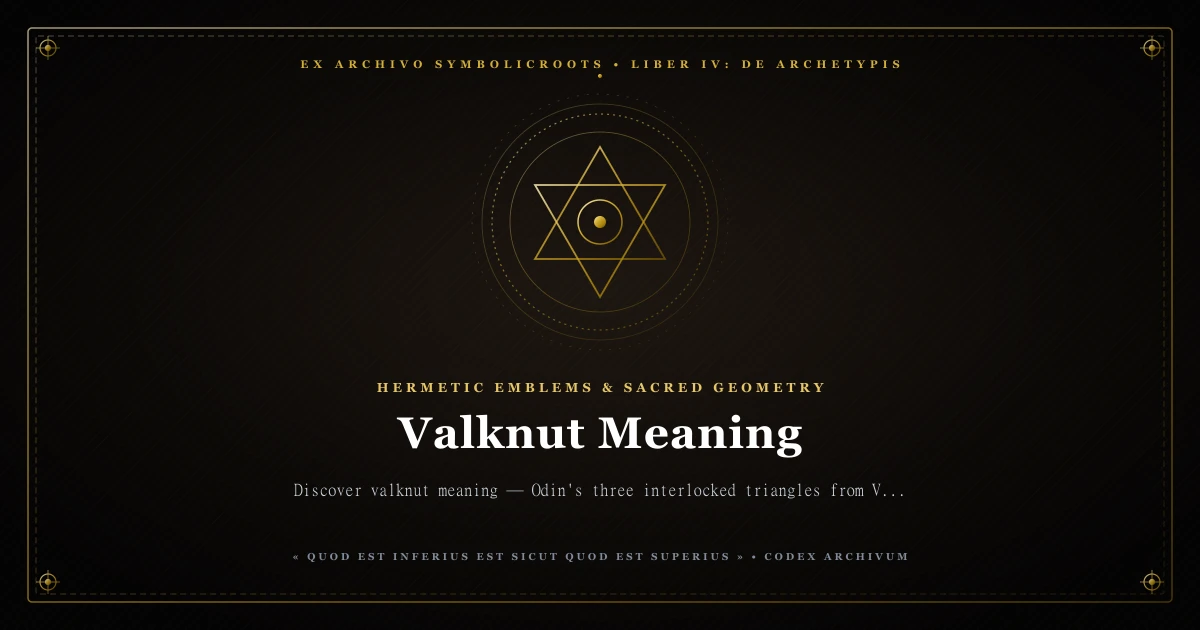
"The valknut — three interlocked triangles carved beside Odin on Viking memorial stones — is Norse art's great knot of devotion: a mark of Odin's chosen, of warriors who died with honor, and of the truth that three separate strands can be one unbreakable thing. Its modern life is complicated: worn by pagans as a faith-sign, and misappropriated by extremists — this guide holds the full history."
Tune your mind while reading with pure acoustic frequencies (Web Audio).
Index of Sections (7)Tap to expand ↓
Three triangles, woven so that none can be removed without unraveling all: carved beside a one-eyed god and his ravens on Viking memorial stones, placed in the ships of the honored dead. The valknut is Norse art’s most striking knot — and its name is a modern guess at a symbol whose true name died with its carvers.
This guide decodes the knot of the slain: its archaeology, its theology, its geometric doctrine, and the honest complexity of wearing it today.
Every symbol in this archive is traced through its cultural lineage and its psychological mechanism, with sources listed at the end.
1. Universal Meaning: Three Strands, One Unbreakable
The valknut’s power begins with its geometry:
- The interlock doctrine: Each triangle passes over and under the others — a Borromean-style knot (in its looped form) where the whole holds only because every part holds. The symbol’s one native claim: three separate things, one structure. No strand is dispensable.
- The three readings: What the three are — the realms (Asgard, Midgard, Helheim), the self (heart, mind, spirit), fate’s three threads (the Norns weaving past, present, future) — is modern interpretation. The ancient certainty is only this: three of something sacred, bound.
- The death-and-devotion context: Every archaeological appearance is funerary or Odinic — the knot marks the god who claims the honored dead for Valhalla. The valknut is therefore a commitment mark: the sign of those who belong to Odin’s company — devotion that outlasts life.
- The unnamed symbol: Vikings left no inscription naming it. “Valknut” — knot of the slain — was coined in modern Norwegian; the Vikings knew it, and we know it was theirs, but not what they called it. A symbol with a lost name and a living shape.
2. The Archaeology: Stones, Ships, and the Nine Worlds
1. The Tängelgårda Stone (Gotland, ~700 CE)
The knot’s most famous appearance: a Gotlandic picture stone showing a warrior with a ring-adorned horse leading a column of armed men — and above the scene, three interlocked triangles and Odin’s ravens. The reading: the devoted dead being led into Odin’s company — the valknut as the flag over the procession of the chosen.
2. The Oseberg Ship Burial (~834 CE)
Norway’s most famous Viking ship tomb carried valknut-like knotwork on a bedpost and other artifacts — the symbol present at the burial of a queen-level figure, with the goods for the journey. Funerary again, precisely.
3. The Nine Worlds Geometry
Norse cosmology counts nine worlds on the world-tree Yggdrasil — and the valknut’s nine angles read, in modern Heathen practice, as a map of those nine: three triangles, three sides each, nine corners. The geometry is too neat to resist, too late to confirm — which is itself the Norse way: the sagas would approve of a symbol that keeps its mystery.
4. Odin’s Knot
Odin’s own mythology is knot-shaped: nine nights hanging on Yggdrasil to win the runes, the9 limbs of his teasings of fate, the triple na… — the tradition binds threes and nines wherever Odin walks. The valknut as his knot — the knot of the god who traded an eye for wisdom and himself for the runes — completes the reading: wisdom costs, and the cost is woven in.
3. Psychological & Jungian Depth: The Binding Complex
In Jungian terms, the valknut personifies integrated commitment — the psyche’s capacity to bind three commitments into one life without any unraveling:
- The three-threads audit: The valknut asks the warrior’s question in civilian dress: what three things are yours to hold — and do they interlock, or do they tug apart? A life of work, love, and faith that interlock is armor; the same three un-integrated is three separate escape routes.
- The honored-death reading: Less morbid than it sounds: the valknut marks endings accepted as part of devotion. Its wearer acknowledges that some commitments are terminal — the promise that does not have an exit clause. Modern translation: know which of your commitments are valknut-grade.
- The appropriation shadow: A symbol’s meaning is partly wear-manufactured. The valknut’s 20th-century misuse by extremists added a shadow the Vikings never carried — and the Heathen response (reclamation through visible, knowledgeable, respectful wear) is itself a living lesson in symbol-stewardship.
4. The Valknut Across Life Domains
1. In Identity and Heritage
For descendants of Norse heritage and Heathen practitioners, the valknut functions as faith-sign and family-flag. Its counsel is the archaeologist’s: wear it knowing — the symbol honors those who can tell its story, and confuses those who cannot.
2. In Discipline and Purpose
As a personal emblem, the valknut is the totem of the three-fold commitment: pick your three (craft, people, creed) and bind them — then refuse the modern reflex of quarterly re-selection. The knot’s geometry is the argument: interlocking is strength; it is also inconvenience. That is the price and the point.
3. In Facing Endings
Spiritually, the valknut is the death-worker’s symbol in the healthiest sense: the Norse refused neither death nor its honors — burials were ships, pyres, and stones with the knot above. Its practice: name your ending-preferences, honor your dead formally, and treat mortality as membership rather than emergency.
5. Somatic Practice: The Three-Thread Knot
Anchor the symbol with this two-minute protocol:
- Weave the fingers. Interlace the fingers of both hands — two triangles of knuckles meeting. Feel the interlock: pull one finger and the whole structure answers.
- Name your three. Silently speak your three commitments — the strands the knot binds. If one has no name, the knot has a missing strand; that is the week’s finding.
- Pull once, gently. Tug the interlocked hands apart slightly — feel the whole resist. Say silently: “Bound, not tangled.” Commitment that can breathe and still holds — the valknut’s actual geometry.
6. Actionable Steps & Companion Symbols
- Learn before you wear. If the valknut calls to you, learn the Tängelgårda story and the appropriation debate — the symbol’s respect-code is knowledge, and it is a two-minute study.
- Bind your three. Write your three strands and one sentence about how they interlock (how craft funds family, how family grounds faith). Un-interlocked triads are just to-do lists.
- Honor one dead. The valknut is a memorial stone in origin: give one honored dead — ancestor, mentor, friend — a formal remembrance this week: the toast, the stone raised, the story retold.
- Go deeper. Meet the valknut’s Norse kin and knot-family — the raven-carriers in Raven Spiritual Meaning and Black Crow Spiritual Meaning, the wolf-medicine in Wolf Spiritual Meaning, and the death-honoring register in Death in a Dream Meaning. For the geometry of interlocking, see Flower of Life Meaning and Triquetra Celtic Knot Meaning; browse the full Cultural Archetypes & Symbols archive, and keep your bindings recorded in the Printable Dream Journal.
Where did you encounter Valknut Meaning today?
Personal Integration Prompts
Carl Jung taught that archetypes remain powerless until integrated into waking conscious awareness. Sit with these questions before moving on:
- What recurring situation or emotional friction in your life mirrors this symbol's primary message right now?
- If this sign were a messenger from your subconscious, what uncomfortable truth is it asking you to stop ignoring?
- What is one concrete, grounded boundary or action you can execute in the next 24 hours to honor this insight?
"Valknut Meaning: Odin's Knot, Warriors & Norse Lore"
"The valknut — three interlocked triangles carved beside Odin on Viking memorial stones — is Norse art's great knot of devotion: a mark of Odin's chosen, of warriors who died with honor, and of the truth that three separate strands can be one unbreakable thing. Its modern life is complicated: worn by pagans as a faith-sign, and misappropriated by extremists — this guide holds the full history."
Frequently Addressed Inquiries
What does the valknut symbolize?
Is it OK to wear a valknut today?
What do the three triangles represent?
Where does the valknut appear in Viking archaeology?
Sources, Literature & Academic Citations
Unlike generic folklore websites, every interpretation in the SymbolicRoots archive is grounded in published depth psychology, cognitive neuroscience, and foundational anthropological texts:
- [1]Eliade, Mircea (1961). "Images and Symbols: Studies in Religious Symbolism." Harvill Press / Princeton University Press.
↳ Focus: The structure of sacred space, alchemical seals, and the persistence of primordial symbolic architectures across civilizations.
- [2]Zimmer, Heinrich (1946). "Myths and Symbols in Indian Art and Civilization." Bollingen Series VI, Princeton University Press.
↳ Focus: Exegesis on geometric mandalas, the serpent Ouroboros, cosmic trees, and cyclic alchemical transformation.
- [3]Hall, Manly P. (1928). "The Secret Teachings of All Ages: An Encyclopedic Outline of Masonic, Hermetic, Qabbalistic and Rosicrucian Symbolical Philosophy." H.S. Crocker Company.
↳ Focus: Historic sourcebook tracing ancient Near Eastern, Hermetic, and Pythagorean sacred geometry and talismanic emblems.
Alex Brovarsky
Founder & Editor
Founder and editor of SymbolicRoots. Reads dreams, signs and symbols through depth psychology and cultural tradition, listing sources for every article.