Pentagram Meaning: The Five-Pointed Star's True History
Founder & Editor • Published
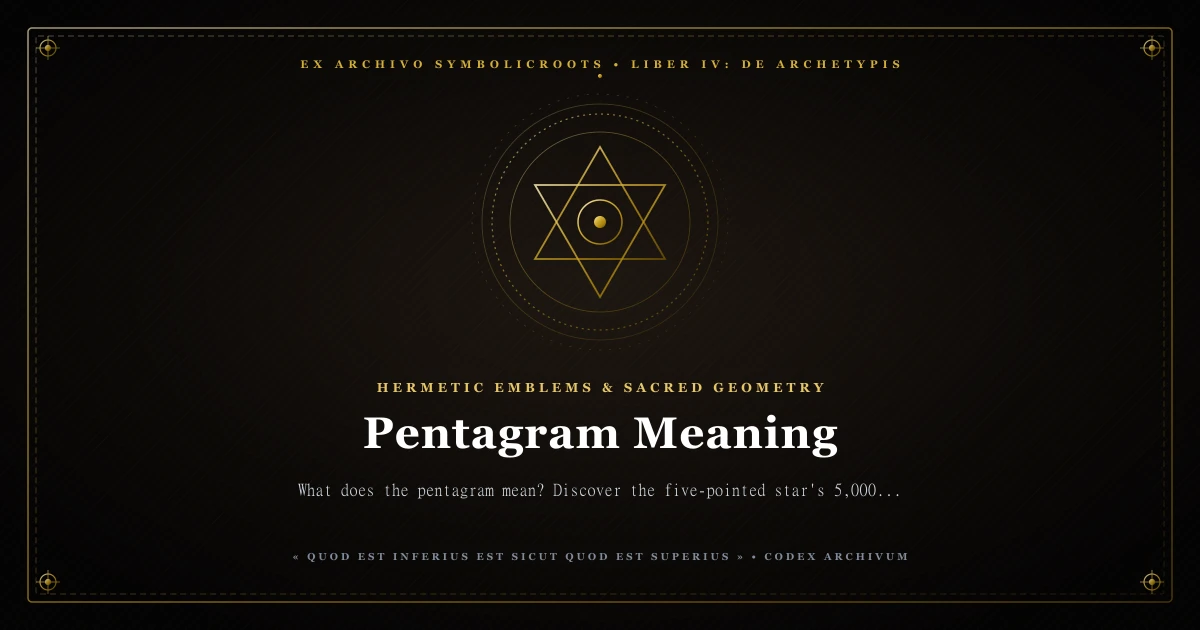
"The pentagram is one of humanity's oldest symbols — a five-pointed star that has meant protection, perfection, and the golden ratio for most of its 5,000-year history. Its modern reputation as 'satanic' dates only to the 20th century; for most of its life it guarded doorways, crowned Christian kings, and encoded Pythagorean mathematics."
Tune your mind while reading with pure acoustic frequencies (Web Audio).
Index of Sections (7)Tap to expand ↓
Draw five straight strokes without lifting the pen and you have drawn one of humanity’s oldest signatures — a star that guarded Sumerian city walls, crowned Christian knights, encoded the mathematics of beauty, and only recently acquired the darkest reputation of any shape in the world.
The pentagram’s true history is one of the great symbol rehabilitation stories waiting to be told. This guide traces the five-pointed star across five millennia — and explains exactly how a protection symbol became a panic symbol, and what it actually means.
Every symbol in this archive is traced through its cultural lineage and its psychological mechanism, with sources listed at the end.
1. Universal Meaning: Five, the Human Number
The pentagram’s power begins with its anatomy — five points, five strokes, and a geometry nobody designed:
- The Human Star: Stand with arms and legs outstretched and the body describes a five-pointed star — head, two hands, two feet. Renaissance artists drew the Vitruvian tradition this way; Agrippa’s 16th-century diagrams made the correspondence explicit. The pentagram is the human figure, abstracted.
- The Five Elements: In Western esoteric tradition the five points carry spirit, air, fire, water, and earth — the whole material and supersensible inventory on one star.
- The Golden Prison: Every intersection of a pentagram’s lines divides them in the golden ratio — phi (≈1.618), the proportion the human eye finds most beautiful. The star is phi made visible; its endless self-similar nesting (draw a star inside its inner pentagon, repeat forever) makes it geometry’s proof of infinity in miniature.
- Unbroken Protection: Drawn in five continuous strokes, the pentagram has served as a seal across cultures that never compared notes — the closure itself, the line returning to its start, is the protective logic: no gap for harm to enter.
2. A Five-Thousand-Year History
1. Mesopotamia (c. 3000 BCE)
The earliest pentagrams appear on Sumerian pottery and cylinder seals, and in Uruk the five-pointed star was the cuneiform sign for the regions of the world — the star as a map of totality. From its first appearance, the shape meant everything, held together.
2. Pythagoras and the Brotherhood of the Star
The Pythagoreans (6th century BCE) adopted the pentagram as their badge of recognition — the pentalpha, five interlocked letter-A’s. For the first school to prove the golden ratio’s mathematics, the star was their discovery worn on the sleeve: health, harmony, and mathematical beauty in one glyph. Greek coins minted the star; the healing tradition of Hippocrates’ followers reportedly used it as a health emblem.
3. The Christian Pentangle
Medieval Europe carried the star into church architecture and chivalric legend. The 14th-century poem Sir Gawain and the Green Knight devotes a famous passage to the “pentangle of five wits, five fingers, five wounds of Christ, five joys of Mary, and five virtues” — the star emblazoned on Gawain’s shield as a Christian truth-symbol. Kings from Jerusalem to England used five-pointed stars on seals and crowns. For a thousand years, the pentagram was squarely, officially Christian.
4. The Occult Centuries and the Great Rebrand
Renaissance magic (Agrippa) formalized the elemental correspondences; 19th-century occultists — most famously Éliphas Lévi — introduced the influential idea that orientation determined meaning: point-up for the spirit’s rule over matter, point-down for matter’s rule over spirit. Lévi drew the inverted form with a goat’s head as a deliberately provocative image of the material principle. The 20th century completed the rebrand: filmmaker and pop-culture machinery adopted the inverted star as horror shorthand, and the pentagram — protective for 4,900 of its 5,000 years — became the world’s most typecast symbol.
3. Pentagram, Pentacle, Inverted: The Orientation Map
| Form | Traditional Reading | Historical Users |
|---|---|---|
| Point-up pentagram | Spirit governing the elements; protection, harmony, the upright human | Pythagoreans, medieval Christians, modern Wiccans |
| Point-up pentacle (circled) | Unity containing the five — the sealed protection | Ceremonial magic, Wicca |
| Point-down pentagram | Matter over spirit; in the 20th century, adopted as a baphometic emblem | Lévi’s era occultism; Church of Satan (1966) |
| Point-down pentacle | The “second-degree” emblem in some Wiccan training systems | Wicca |
| Five-pointed star (uncrossed, as on flags) | National aspiration, guidance | Dozens of national flags, military insignia |
The table explains the modern confusion in one line: the public associates the shape with its rarest, most recent use — the 20th-century inverted emblem — while forgetting the five millennia of doorway-stars, shield-stars, and flag-stars.
4. The Pentagram Across Life Domains
1. In Protection and Boundaries
As the historical doorway-symbol, the pentagram’s practical inheritance is boundary-craft: the drawn closure as a daily ritual of defining where your space ends. Modern readers keep it as a protective emblem at thresholds — desk, door, phone lock-screen — with the point-up, circled form carrying the tradition’s original logic.
2. In Personal Identity
The human-star correspondence makes the pentagram a symbol of embodied balance: five points, one body, spirit at the crown. As a personal emblem it favors the integrated over the extremes — a reminder that its every proportion is golden: balance, not symmetry.
3. In Spiritual Study
For students of symbolism, the pentagram is a masterclass in how meaning is manufactured: one shape, five millennia, at least six opposite reputations. It teaches the field’s most important lesson — symbols have biographies, and reading them requires history, not reflex.
5. Somatic Practice: The Five-Stroke Draw
Anchor the symbol’s original protective logic with this two-minute protocol:
- Draw the star in the air. With the dominant hand’s finger, trace a five-stroke pentagram slowly at chest height — down-left, across-right, down-left, up, across. Five strokes, one breath each. The closure matters: end where you began.
- Set the five. Name your five supports silently — body, mind, one bond, one craft, one faith — one per point.
- Close the circle. Trace a circle around the star with both arms — the pentacle’s motion — and say silently: “Five points, one boundary, drawn by me.”
6. Actionable Steps & Companion Symbols
- Read the biography before the vibe. Apply the pentagram lesson universally: before adopting or fearing any symbol, spend five minutes on its history — most modern panic-symbols are older and kinder than their reputation.
- Use the human-star check. In posture and planning, spread to five points: spirit at top, two workstreams, two relationships. The star is a life-map before it is an emblem.
- Reclaim the doorway. If a threshold in your home feels porous, the tradition’s answer is the drawn closure — any five-stroke star, drawn with intention, in the old logic.
- Go deeper. Complete the sacred-geometry set: the queen of diagrams in Sri Yantra Meaning, the chariot-star in Merkaba Meaning, the blueprint in Flower of Life Meaning, and its guardian in Metatron’s Cube Meaning. For the ratio hidden in every intersection, see Golden Ratio Meaning; for the number behind the points, 111 Angel Number Meaning and What Are Angel Numbers?; browse the full Cultural Archetypes & Symbols archive.
Where did you encounter Pentagram Meaning today?
Personal Integration Prompts
Carl Jung taught that archetypes remain powerless until integrated into waking conscious awareness. Sit with these questions before moving on:
- What recurring situation or emotional friction in your life mirrors this symbol's primary message right now?
- If this sign were a messenger from your subconscious, what uncomfortable truth is it asking you to stop ignoring?
- What is one concrete, grounded boundary or action you can execute in the next 24 hours to honor this insight?
"Pentagram Meaning: The Five-Pointed Star's True History"
"The pentagram is one of humanity's oldest symbols — a five-pointed star that has meant protection, perfection, and the golden ratio for most of its 5,000-year history. Its modern reputation as 'satanic' dates only to the 20th century; for most of its life it guarded doorways, crowned Christian kings, and encoded Pythagorean mathematics."
Frequently Addressed Inquiries
What does the pentagram symbolize?
What is the difference between a pentagram and a pentacle?
Why does pentagram orientation matter?
Is the pentagram a Christian symbol?
Sources, Literature & Academic Citations
Unlike generic folklore websites, every interpretation in the SymbolicRoots archive is grounded in published depth psychology, cognitive neuroscience, and foundational anthropological texts:
- [1]Eliade, Mircea (1961). "Images and Symbols: Studies in Religious Symbolism." Harvill Press / Princeton University Press.
↳ Focus: The structure of sacred space, alchemical seals, and the persistence of primordial symbolic architectures across civilizations.
- [2]Zimmer, Heinrich (1946). "Myths and Symbols in Indian Art and Civilization." Bollingen Series VI, Princeton University Press.
↳ Focus: Exegesis on geometric mandalas, the serpent Ouroboros, cosmic trees, and cyclic alchemical transformation.
- [3]Hall, Manly P. (1928). "The Secret Teachings of All Ages: An Encyclopedic Outline of Masonic, Hermetic, Qabbalistic and Rosicrucian Symbolical Philosophy." H.S. Crocker Company.
↳ Focus: Historic sourcebook tracing ancient Near Eastern, Hermetic, and Pythagorean sacred geometry and talismanic emblems.
Alex Brovarsky
Founder & Editor
Founder and editor of SymbolicRoots. Reads dreams, signs and symbols through depth psychology and cultural tradition, listing sources for every article.